
- Guided tour only, about 30 minutes. No self-guided ticket and no audio guide.
- Spanish, English, Portuguese and French share one schedule, and you pick at the desk. You may wait for yours.
- 09:00 to 18:30 every day. Shut on 25 December and 1 January, closing at 13:00 on the 24th and 31st.
- The highlight is the Arab Room, and it is in the standard ticket. Nobody needs to pay extra for it.
- Eight minutes from Sao Bento, and two from the Church of Sao Francisco, which is part of the same story.
How you get in
Guided tour only
How long
30 minutes
Languages
Spanish, English, Portuguese, French
Booked
At the desk, on the day
Open
09:00 to 18:30 daily
From Sao Bento
699 m, 8 minutes
The Palacio da Bolsa is the nineteenth-century stock exchange built by Porto's Commercial Association, and it is the most visited paid monument in the north of Portugal, with over 300,000 people a year. It is also not a building you can wander into and look around.
Guided tour only, thirty minutes
The only way in is on a guided tour, and the tour runs about half an hour. There is no self-guided ticket, no audio guide instead, and no option to go at your own pace. You buy a place on the next tour and you go round with it.
That is shorter than most people set aside for a palace, which is good news for a packed morning. The catch is the other half of it: arriving is not the same as entering. There is a wait for the next tour, and the length of that wait depends on something most visitors do not see coming.
Four languages share one schedule
Tours run in Spanish, English, Portuguese and French, and you choose the time and the language at the ticket desk rather than booking ahead. Read from the city tourist board on 27 October 2026.
All four share the same timetable, so you take whichever tour is next in a language you speak. Turn up at a quiet moment and that is five minutes. Turn up at eleven on a July morning and the next English departure may be two or three tours away.
Going early in the day is the practical answer, and it is free. The other answer costs money, and it is the only real reason to consider a booked tour: a private guide runs in your language at the time you picked.
Where to buy, and the combined ticket
Tickets are sold at the desk inside, on the day. There are three ways to do this and they are not close in price.
| Where | Roughly | What it gets you |
|---|---|---|
| The ticket desk, on the day | Around 14 EUR | You take the next tour in a language you speak |
| Combined with the Clerigos tower and the MMIPO | Around 25 EUR | Bought at the Clerigos desk, not here |
| A booked tour with its own guide | From 38.99 EUR | Your language at a time you chose |
The two bookable visits, and what the difference actually buys

Guided visit with a licensed guide, entry included
- Price
- From 38.99 EUR
- Duration
- 30 to 50 minutes
- Rating
The one thing it adds over the desk price is the thing that matters here: your own licensed guide in English or Portuguese, at a time you picked, with no waiting for the rota. Worth knowing before you book that the title says skip the line while the listing’s own skip-the-line field says otherwise, and that the shared group runs to 40. Free cancellation 24 hours before.
Price checked 27 Oct 2026
Check availability
Private guided visit, sold as including the Arab Room
- Price
- From 39.50 EUR
- Duration
- 30 to 50 minutes
- Rating
Private rather than shared, for fifty cents more. Two things to weigh: it is rated 3.5 across six reviews, and the Arab Room in its title is part of the ordinary ticket, so that is not what the premium buys.
Price checked 27 Oct 2026
Check availabilityThe combined ticket is the one worth a minute of arithmetic. The Clerigos tower day ticket is around 10 EUR and this is around 14, so the two separately come to about 24. The combined ticket covering both plus the MMIPO museum is about 25, which adds a third museum for roughly a euro. It is sold at the Clerigos desk, so buy it there and walk down afterwards.
What you see in half an hour
The route is fixed and the guide sets the pace. In order, this is what the thirty minutes covers.
| Room | What it is |
|---|---|
| Patio das Nacoes | The glass and iron courtyard where the trading floor was. Its octagonal dome carries the painted arms of the countries Porto traded with. |
| The staircase | Granite and marble, finished in 1868, with busts by Soares dos Reis and Teixeira Lopes and ceiling frescoes by Antonio Ramalho. |
| Tribunal and Assembly rooms | The working rooms of the Commercial Association, with furniture by Marques da Silva and allegorical paintings by Veloso Salgado. |
| Golden Room | Gilded woodwork and the ceiling that gives it the name. |
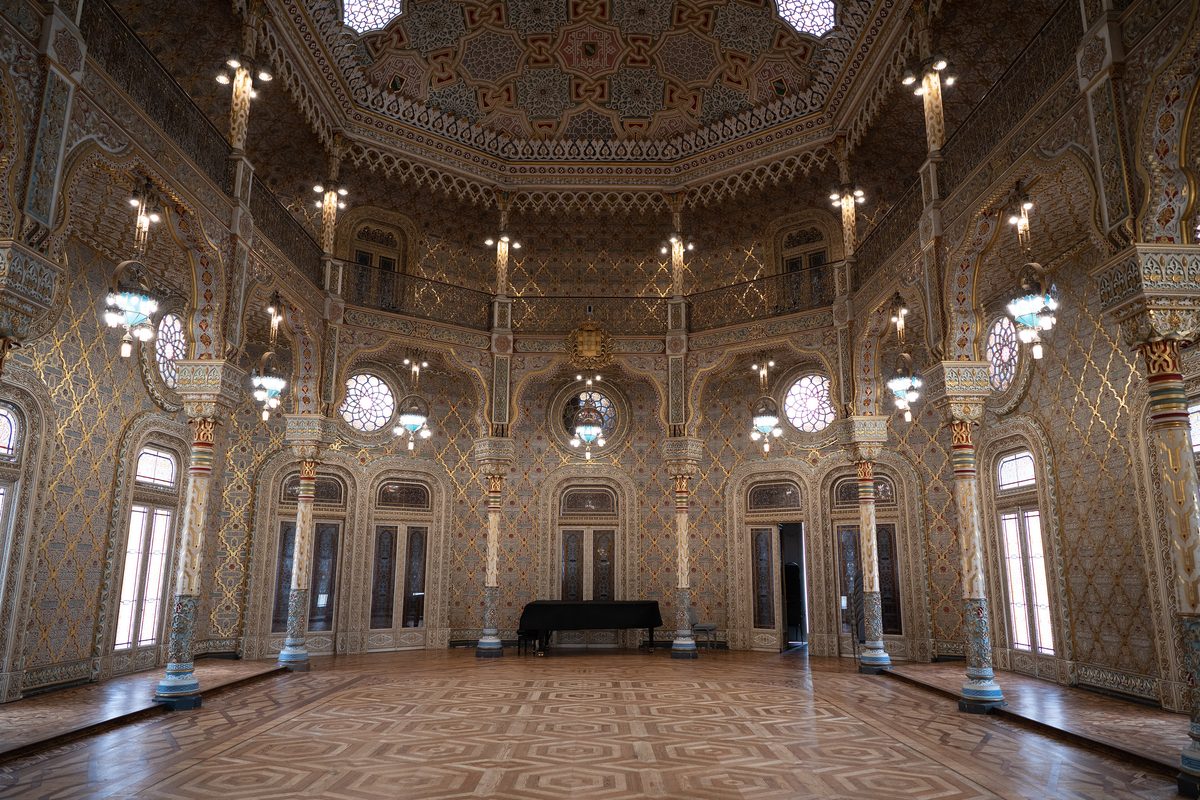
| Salao Arabe | The Moorish Revival ballroom, carved and gilded over every surface. Still used to receive heads of state. |
The Arab Room is the one everyone comes for, and it is the last stop rather than the first, so the visit builds towards it. It is part of the standard ticket. That is worth saying plainly because some tours are sold as including the Arab Room, as though it were an upgrade.
Why it exists, and why it took 68 years
Next door to the palace is the Church of Sao Francisco, and the two are the same story. Both belonged to a Franciscan convent founded in the thirteenth century. In 1832, during the Liberal Wars, a fire destroyed the convent cloisters and spared the church.
In 1841 Queen Maria II gave the ruins to the merchants of Porto, who decided to put their Commercial Association on the site. Building started in 1842 to a neoclassical design by Joaquim da Costa Lima Junior, and the structure was essentially finished by 1850.
The decoration took another sixty years. The interior was not completed until 1910, passing through a series of architects and artists: the dome over the courtyard after 1880, the staircase in 1868, and the Arab Room across eighteen years from 1862. It has been a National Monument since 1982.
That is the thing to carry into the visit. Half an hour is a brisk walk through sixty-eight years of decoration, which is why the guide keeps moving and why the rooms do not match each other.
Hours and the days it shuts
| When | Hours |
|---|---|
| Every day | 09:00 to 18:30 |
| 24 and 31 December | Closes at 13:00 |
| 25 December and 1 January | Closed |
| 28 March to 4 April | Closed |
The 13:00 closes on 24 and 31 December are the ones that catch people out, because the palace is open normally on the days either side. If your trip covers Christmas or New Year, make this a morning. The spring closure, 28 March to 4 April, is the other one to note.
Where it is, and what is next door
The palace sits on the Praca do Infante D. Henrique, between the Baixa and the river, which puts it within a few minutes of most of the centre.
| From | Distance | On foot |
|---|---|---|
| Sao Bento station | 699 m | 8 min |
| Clerigos tower | 655 m | 8 min |
| Church of Sao Francisco | 204 m | 2 min |
| The Ribeira | 345 m | 4 min |
| Livraria Lello | 820 m | 10 min |
The 204 metres to the Church of Sao Francisco are the ones to use. It is the church that survived the fire that created the palace, its interior is carved and gilded in a way that makes the Arab Room look restrained, and it is two minutes away. Half an hour in each is a very good morning.
From here it is four minutes downhill to the river and eight uphill to Clerigos, which is also where the combined ticket is sold.
Questions
Can you visit the Palacio da Bolsa without a guided tour?
No. Entry is by guided tour only and it lasts about 30 minutes. There is no self-guided ticket, no audio guide alternative and no wandering through at your own pace. It is the single thing most worth knowing before you plan the visit, because it means arriving and entering are not the same thing.
What language is the tour in?
Spanish, English, Portuguese and French, and you pick the time and language at the ticket desk rather than booking ahead. The four languages share one schedule, so you join whichever tour runs next in a language you speak. At a busy moment the next English departure may not be the next departure.
How long do you need at the Palacio da Bolsa?
The tour is half an hour, so allow about an hour with the wait for your language. It is one of the quicker paid monuments in Porto, which makes it easy to pair with the Church of Sao Francisco, 204 metres away, or with the Ribeira, four minutes downhill.
Do you need to book in advance?
Tickets are sold at the desk on the day, which is how most people get in. The palace takes over 300,000 visitors a year and a travel forum thread in September 2026 reported dates showing as full, so going early in the day is the safer plan, particularly in summer.
Is the combined ticket with the Clerigos tower worth it?
The arithmetic is unusually favourable. The Clerigos day ticket is around 10 EUR and the Bolsa around 14, so the two bought separately come to about 24. The combined ticket covering both plus the MMIPO museum is around 25, which adds a third museum for roughly a euro. It is sold at the Clerigos ticket office, so buy it there first. Prices read in September and October 2026.
What is the Arab Room?
The Salao Arabe is the Moorish Revival ballroom the palace is famous for, built between 1862 and 1880 by Gustavo Adolfo Goncalves e Sousa and gilded over every surface. It is still used to receive heads of state. It is part of the standard guided visit and not an upgrade, which is worth knowing because some tours advertise it as though it were an extra.
Is the Palacio da Bolsa accessible?
The city tourist board lists it as accessible for people with reduced mobility through a side entrance. The visit does include a staircase to the upper floor, so it is worth asking at the desk how the route works on the day.
Header photograph: Palacio da Bolsa Arab Room (42141799374) by Nan Palmero from San Antonio, TX, USA, licensed under CC BY 2.0. Cropped to fit.
Written by Diego Fresno, who checked how the visit works on the day: guided tour only, half an hour, four languages sharing one timetable, and a decoration programme that ran from 1842 to 1910. Verified quarterly: last review October 2026. About the author →